comments 2

Tall order

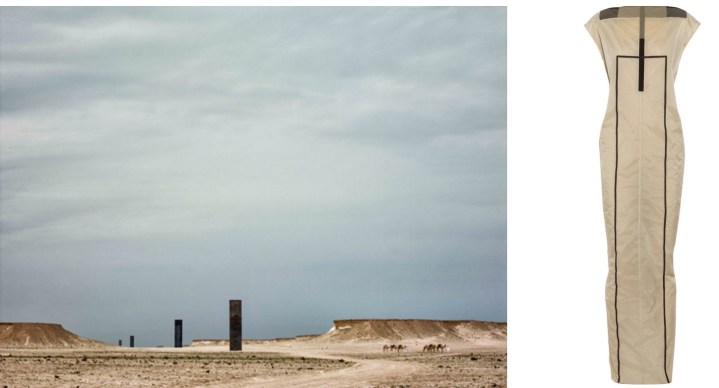
East-West/West-East" by Richard Serra in Qatar paired with Rick Owens Dagger Coated Chiffon Dress.

East-West/West-East” by Richard Serra in Qatar paired with Rick Owens Dagger Coated Chiffon Dress.


A monumental mirage began with a memory. The former Emir of Qatar shared a childhood snapshot with sculptor Richard Serra – of antelope gathering on a gypsum plateau in the western Qatari desert. During the year Serra spent scouting locations for his second sculpture in Qatar – Sheikha al-Mayassa Hamad bin Khalifa al-Thani of the Qatar Museums Authority had charged the American artist with “building a piece in the landscape” – Serra visited the poignant site in the Brouq Nature Reserve, describing it as “John Ford country, only much more evaporated.” Ergo the reciprocal resonance of the site-specific work’s title, East-West/West-East, which also references the latitudinal orientation of the four steel plates, irregularly planted along the chalky corridor. The monoliths stand between 48 and 55 feet tall – level with the plateaus – across a half-mile stretch connecting the borders of the desert peninsula, located about 35 miles outside Doha. The quartet is visible in toto from either end, and so far, the droves driving out to visit the site have made laps of its full length. The plates, rolled in Germany, are made of the same steel Serra has used in other pieces, so they will oxidize in the same way, albeit more quickly: in the two months since the sculpture’s unveiling, the desert has painted orange streaks on its charcoal grey walls, well on its way to the ultimate dark amber.

East-West/West-East writs large Serra’s genius for carving – with imposing metal strokes – timelessly intimate moments out of expanses, a practice particularly profound in the desert where people arrive attune to solitary contemplation. “This place makes a space within that place to walk and measure yourself against the rise and fall of the landscape,” Serra said. “[It] collects the space.” A rectilinear sanctum reflected in this column dress by Rick Owens, which (almost) abides by Qatar’s modest dress code calling for coverage from shoulders to knees. I would add a cardigan for decorum and desert winds.

comment 0

B(u)ildungsroman

Cocoon and Cranes Hong Kong 2008 by Peter Steinhauer paired with Vionnet Tulle and Pleated Crepe Dress.

Cocoon and Cranes Hong Kong 2008 by Peter Steinhauer paired with Vionnet Tulle and Pleated Crepe Dress.


A building sheathed in fabric conjures a Christo and Jeanne Claude creation. So thought photographer Peter Steinhauer when he deplaned in Hong Kong and spotted a skyscraper draped in yellow scrim. And then another, a column of green, and another, beige. “I kept thinking about the metamorphosis,” Steinhauer said in a post on the New York Times’ Lens blog. “I thought caterpillars to butterflies and then my wife said, ‘cocoon.’ It just stuck.”

Stuck as a passion project. Steinhauer has spent the past decade documenting this peninsular phenomenon: in Hong Kong, when buildings are being built, renovated or demolished, crews construct bamboo cages and strung with silken nets to catch debris and dust. Scaffolding, gone beautiful. Steinhauer’s daily routine finds him up early driving around the city, scouting for new shades. The canary color of his first sighting has proved to be a rare specimen; green and beige are most popular. Often his frames are found by mild subterfuge – a fake cell phone conversation or mountainside vantage point. Nighttime lends a sci-fi filter to his photos, an eerie glow cast by the sodium vapor lights attached to cranes.

Invariably, residents looked on his creative focus with disdain. But only when his apartment complex was poised to be shrouded during renovation did his veil of wonder lift: he shuddered at the prospect of spending nine months looking out at a green world. His personal inversion, from exterior appreciation to interior aversion, makes his photographs all the more nuanced: How many lives are caged in by colors?

comment 0

Play me

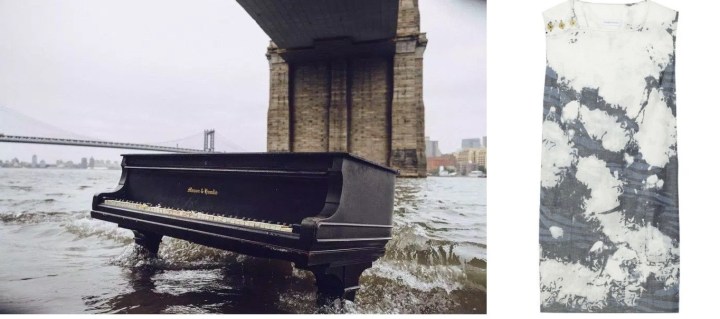
A grand piano has appeared on the Manhattan-side of the East River paired with Pierre Balmain Chambray Dress.

A grand piano has appeared on the Manhattan-side of the East River paired with Pierre Balmain Chambray Dress.


A grand piano is beached on the Manhattan shore of the East River beneath the Brooklyn Bridge, lodged in sand, submerged at high tide. New Yorkers are perplexed: not part of a previous art installation, the piano appeared out of thin air last week, too waterlogged to play. “Is it possible,” Gothamist asked, “that the piano washed ashore in one piece?” A city bewitched: plucky players are tickling its mute ivories, taking photos, packing picnics. The piano – long a foil for life with its capacity for both discord and harmony. This piano – a silent stand-in for New York stories, for pasts as mottled as this dress, an urban UFO. Its soaked symbolism recalls a Tom Waits-ism: “The piano has been drinking, not me.”

comment 0

River dance

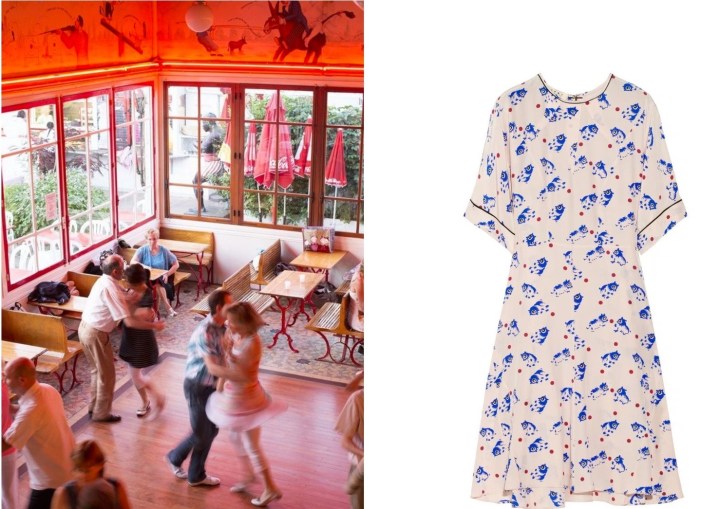
Chez Gégène on the Marne River outside of Paris (photograph by Tara Donne for Afar) paired with Marni Printed Silk Dress.

Chez Gégène on the Marne River outside of Paris (photograph by Tara Donne for Afar) paired with Marni Printed Silk Dress.


A return to relaxed French mores but this time to a site suited to the Impressionism of summer Saturdays – saturated by sun, softened by leisure, vivid with laughter. Generations of Parisians have escaped the city by traveling mere miles to guinguettes, riverside pavilions that pepper outlying waterways (they began as a form of tax evasion – Paris’ steep wine levies compelled schemers to set up shop just beyond city limits – and continued to skip downstream as Paris swelled in size). Then as now, the guinguettes offered a carefree equation of simple fare, cheap wine, and live music, alluring to all. At the height of their Belle Époque heyday, Auguste Renoir painted Luncheon of the Boating Party, a scene quintessential of the guinguettes’ merry mingling of classes. A modern-day Saturday spent at Chez Gégène on the Marne River promises a similarly inclusive experience as all ages take to the dance floor or dine at tables draped in gingham. As (Marni) dresses swirl and boater hats tip, guests find themselves transported back to blitheness. “What happened on the banks of the Marne stayed on the banks of the Marne,” a historian said in an AFAR article, a slogan still in place (play).

comment 0

Fez perfection

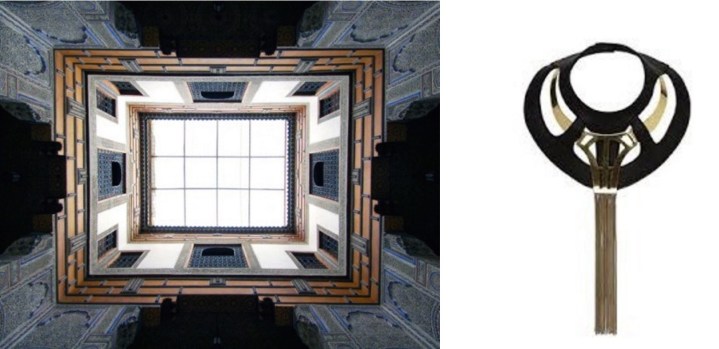
The Dar Seffarine in Fez, Morocco paired with Sass & Bide How Do You Do? Neckpiece.

The Dar Seffarine in Fez, Morocco paired with Sass & Bide How Do You Do? Neckpiece.

Twenty-five craftsmen spent two years resuscitating a 600-year-old residence in the ancient medina of Fez, Morocco, a painstaking labor of love led by husband and wife Iraqi architect Alaa Said and Norwegian graphic designer Kate Kvalvik. The result: The Dar Seffarine guesthouse, a seven-room showpiece of Moorish architecture. A careful edit of contemporary additions, like clean white walls, serve to accentuate the structure’s original glory of zellij (mosaic tile) floors, cedar ceilings, and soaring columns. Rooms ring a central courtyard, open to the sky (as pictured) and accessible by towering 12-foot-tall carved doors. A rooftop terrace offers panoramic views of the ancient pedestrian city. There, I would wear this Sass & Bide leather breast plate, a saucy complement to the layered life of the heritage hotel.

comment 0

Sienna solitude

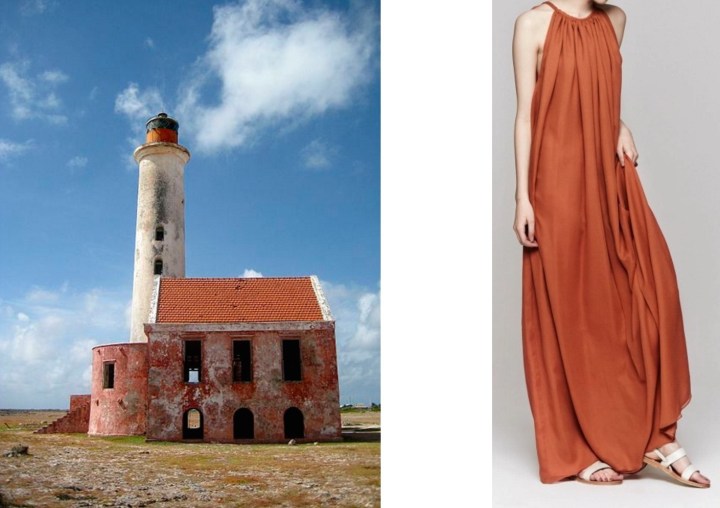
The Lighthouse at Klein Curaçao paired with Heidi Merrick Grecian Dress.

The Lighthouse at Klein Curaçao paired with Heidi Merrick Grecian Dress.


Desert islands do not have to be deserts. This incongruity occurred to me as I read about Noma chef René Redzepi’s picks for BBC Radio 4’s Desert Island Discs. The septuagenarian broadcast asks luminaries to choose eight pieces of music, a book (in addition to the Bible and The Complete Works of Shakespeare) and a luxury. For the latter, Redzepi considered a “sun-driven espresso machine,” but instead identified something that would remind him of home (Copenhagen): “one full day of snow.” If waves threatened to wash away his cache, forcing him to save only one album, he would clutch “One” by Metallica. Before I can come up with my desert island discs, I need to first imagine my isle: Klein Curaçao suits with less than a square mile of sandy expanse shaded by sporadic coconut palms, offering the Caribbean country’s longest and whitest beach uninhabited by people save for passing fisherman and swimming divers. I would play my music and read Shakespeare in this crumbling 19th-century lighthouse, donning this Grecian dress, which would double as a picnic blanket, hammock or sunbrella. Alone but not deserted.

comment 0

Sink or swim

The outdoor pool at the Molitor in Paris, France.

The outdoor pool at the Molitor in Paris, France.

Clover Canyon Olive Tree Two Piece.

Clover Canyon Olive Tree Two Piece.


This is where the bikini made its debut in 1946. For decades, this is where Paris has gone to loosen up (its swimsuit strings). This is the ultimate pool party.

Modeled after an ocean liner, Piscine Molitor opened as a public swimming pool in 1929, a place for the upper crust to exercise and cool down under the watchful eye of lifeguards/American Olympiads Aileen Wiggin and Johnny Weissmuller (who went on to become Hollywood’s Tarzan). Designed by architect Lucien Pollet, the Art Deco icon become symbolic of erotic possibility in Paris, awash in myth and mystique.

When the pool shuttered in 1989, street artists took over (while politicians wrangled), emblazoning the cement expanse with graffiti. In 2007, the city began the redesign process, inviting bids and ultimately awarding the contract to French hotelier Accor plus partners. Embarking on a meticulous (and expensive) renovation, the group resurrected the Molitor as a 124-room luxury hotel (officially opened last week), rehabbing mosaic walls and stained-glass windows, adding a two-story annex, a spa, rooftop terrace and restaurant, and outfitting rooms with Art Deco-inspired contemporary furniture, Bose stereos and espresso makers. While still “public,” entrance prices have become prohibitive: local schoolchildren may swim for free, but the general public must pay steep fees.

In an interesting turn of historical memory, urban artists have been warmly welcomed at Molitor, with a nonprofit Poolartlife formed to foster creative happenings and an opening exhibition staged to showcase the spray-paint palimpsest. A bifurcated treatment of the past, reminiscent of the split-in-two swimwear synonymous with the site.

comment 0

Sea level

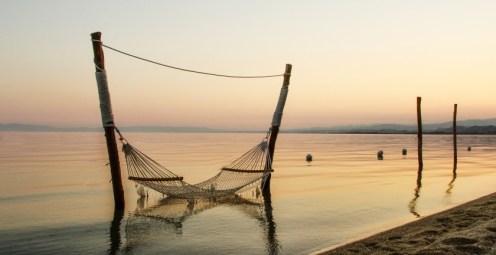
Praia Art Resort in Calabria, Italy.

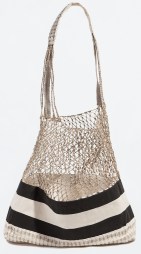
Zara Combined Handbag

Zara Combined Bag.


And so summer begins. The brimming season. In my mountain town, summer brings a frenzy of work and play, strangers and friends. This scene, set at an art-oriented resort on the Italian toe, reminds me to be serene, to doze in hammocks, to dangle fingers in water, to dress in towels.

comment 0

New troubadours

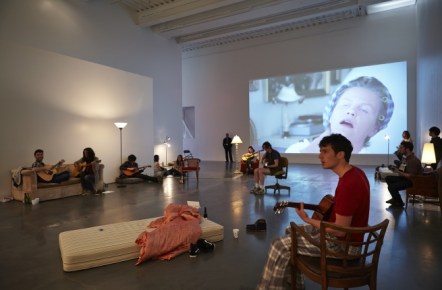
Me, My Mother, My Father and I by Ragnar Kjartansson at the New Museum.

Take Me Here by the Dishwasher: Memorial for a Marriage (2011/2014) by Ragnar Kjartansson at the New Museum in NYC.

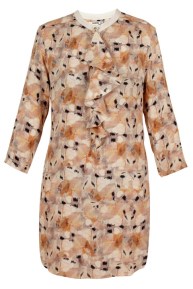
Valentine Gauthier Walter Dress Roche Print.

Valentine Gauthier Walter Dress Roche Print.


A musical marathon is happening at the New Museum in Manhattan. Ten male guitarists are playing and singing continuously all day Wednesday through Sunday until June 29 as part of a new piece created by Icelandic artist Ragnar Kjartansson and composed by fellow Icelander Kjartan Sveinsson, formerly of Sigur Rós. All this stoked by unlimited beer (NYC’s anti-smoking ordinance thwarted unlimited cigarettes), comfy seating (loveseats, mattresses, couches, rolling chairs) and loungewear (Kjartansson encouraged homey attire: pajamas, underwear). The polyphonic performance anchors Kjartansson’s first New York museum exhibition, “Me, My Mother, My Father, and I.”

The makeup of the ad hoc orchestra, including three alternates, testifies to the tapestry of talent in NYC: singer-songwriters, subway buskers, Berklee College of Music grads, a studying music critic. Underpinning this rhythmic tide is a looping scene from one of the first feature films made in Iceland (1977), in which a sexy housewife (whose 2014 self would wear this dress) imagines seducing a plumber by the dishwasher. The actors are the artist’s parents – according to family legend, he was conceived the night after filming – and the lyrics are lines plucked from the film’s dialogue. “All of these people singing about the birth of an artist!” Kjartansson proclaimed in The New Yorker. “It’s kind of disgusting and I’m excited about that.” Or, as his mentor, conceptual artist Magnus Sigurdarson once said, “It’s more than magnificent, it’s mediocre.”

The New Yorker art critic Peter Schjeldahl described the experience as telescopic, moving as he did from observation of individual idiosyncrasies into a wide-angle pathos, “a comprehensive resonance, with a rising and falling rhythm like that of heavy surf or the slow beating of a giant’s heart. There’s a sense of being party to something that is larger than yourself and the players and the artist and the museum.” One more stop on my tri-state summer to-do list.

comment 0

Truck stop

Dan Colen: Help! at The Brant Foundation Art Study Center in Greenwich, CT.

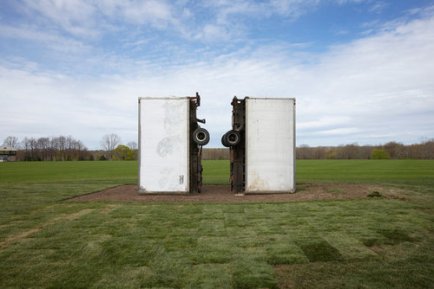
At Least They Died Together (After Dash) by Dan Colen at the Brant Foundation Art Study Center in Greenwich, CT.

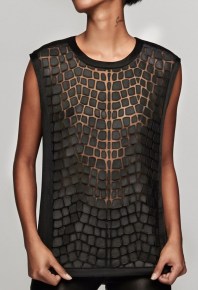
Helmut Lang Silk Combo Tank.

Helmut Lang Silk Combo Tank.


Twin box trucks are planted in a polo field in my hometown – cabs buried, back doors flung open to the elements. Parallel sentinels, stripped of signage, sharing the manicured expanse with a 43-foot-tall topiary Puppy by Jeff Koons.

Artist Dan Colen titled the piece At Least They Died Together (After Dash), referencing his late creative cohort Dash Snow, who died of an overdose in 2009. The name complicates the scenario: Have the trucks dropped from the sky, or grown from the ground? Is this a burial or a planting? Will life grow from it, or be memorialized?

Last weekend, the duo I.U.D. climbed atop the trucks, each musician on her own perch (doors closed for the concert). Their noise music capped the luncheon launch of Colen’s retrospective Dan Colen: Help! at the Brant Foundation Art Study Center in Greenwich, CT.

Inside the barn-like Center, a series of installations dialogue with the dialectic parked outside: 23 canaries fly around a nest of trash metal, caged in by curtain of 150,00 glass crack pipes filled with rosebuds. In keeping with his iconoclastic practice, Colen blurs high and low; ephemera and excrement equalize the high-art effect of the exhibition’s setting. Before Help! closes in September, I want to scour the grounds for tire tracks, evoked by this leather-tred top.