comment 0

Go easy

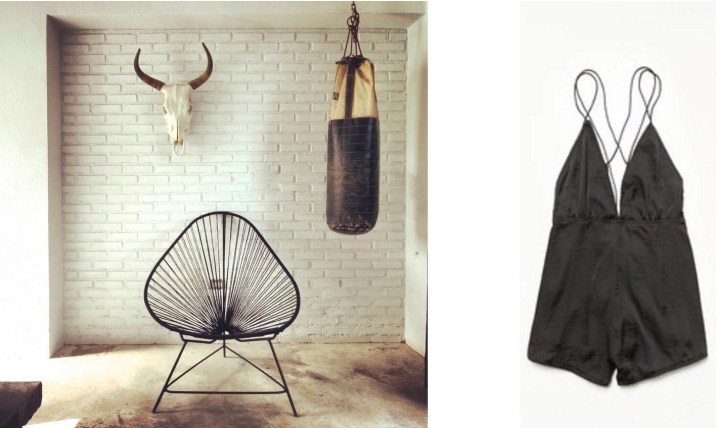
A guest room at the new Drift San Jose in Baja California Sur, Mexico paired with Free People Losin It Romper.

A guest room at the Drift San Jose in Baja California Sur, Mexico paired with Free People Losin It Romper.


A place to be. With a trio of oddly awesome accoutrements: an Acapulco chair as cradle, a vintage punching bag as outlet, a cow skull as witness. I’d go easy, in a romper, and let myself drift off, away.

comment 0

On ice

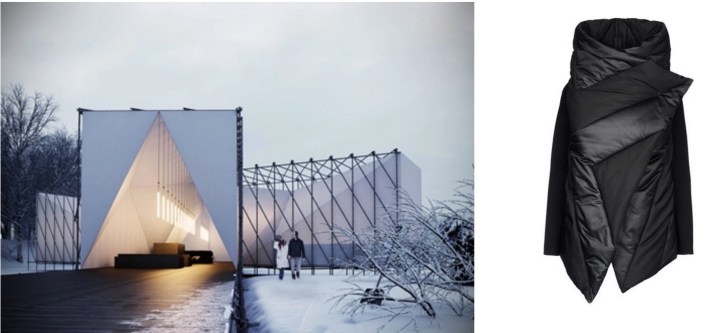
RAW:almond pop-up restaurant atop the Red River in Winnipeg, Canada paired with Gareth Pugh Asymmetric Padded Jacket.

RAW:almond pop-up restaurant atop the Red River in Winnipeg, Canada paired with Gareth Pugh Asymmetric Padded Jacket.

Usually at this time of (new) year, the escapist in me hightails it south to sun and sand. As per my resolutions, I’m trying to embrace my wintry reality by imagining myself at this chic shelter atop a frozen confluence in Winnipeg, Canada. More than a roof, RAW:almond is a pop-up restaurant claiming to be the first of its kind (its “kind” being fine dining on ice). Channeling the geography of the site – where the Assiniboine empties into the Red River – British studio OS31 came up with the winning design concept: a X-shaped structure symbolizing the rivers’ crossing, framed in metal, sheathed in snowdrift-like white. RAW opens its frigid doors on January 22; resolution fulfillment has never felt so fashionable.

comment 0

Double consciousness

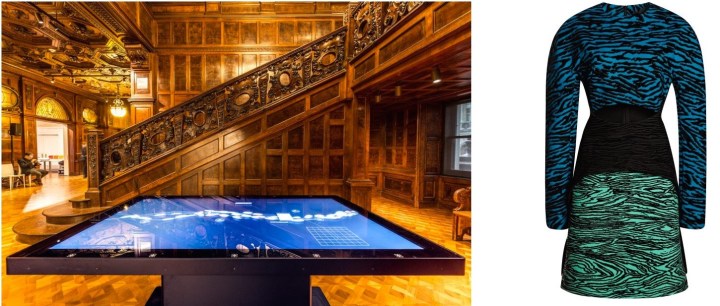
 The main entrance hall of the just reopened Cooper Hewitt, Smithsonian Design Museum in New York (Photo by Max Touhey/Curbed) paired with Proenza Schouler Printed Crepe Wood Grain Dress.


The main entrance hall of the just reopened Cooper Hewitt, Smithsonian Design Museum in New York (Photo by Max Touhey/Curbed) paired with Proenza Schouler Printed Crepe Wood Grain Dress.


Flashback to Friday: On the exact date Andrew Carnegie moved into his new mansion on 91st Street and Fifth Avenue in Manhattan, the stately structure reopened anew, 112 years later, as the freshly renovated Cooper Hewitt Smithsonian Design Museum.

Carnegie Mansion has always captained technology: in 1902, it was the first American residence built with a steel frame, and among the first outfitted with a private Otis elevator and central heating. Ever on the cultural frontier as well, it was the first mansion (nay new home) on the Upper East Side, then considered the derelict outskirts of New York City.

Last Friday, the mansion reemerged on the vanguard of museum studies: the innovation it showcases has always stood in stark contrast to the walls it preserves, but now, the juxtaposition of history and futurism feels more fitting, thanks to a three-year, $91-million renovation by a garrison of creatives led by Gluckman Mayner Architects. As soon as visitors step inside, they are encouraged to think and do like designers via table-size touch screens scattered throughout the aggrandized exhibition space. The activities sound simple – redesign the stuff in your pocket, design a dog tent, invent a lampshade – but the premise is revolutionary: the world, as framed by the museum, is ripe for reinterpretation, personalization, improvement by you. Who knew coffered oak ceilings and interactive digital displays could make such strangely beautiful bedfellows? (Proenza Schouler did, in this bold faux bois number.)

At long last, the mansion is fulfilling the ethos embedded within its architectural bones. Andrew Carnegie had inspirational slogans carved into the walls of his study to encourage contemplation: “Let There Be Light,” “All is Well Since All Grows Better” and “The Aids To A Noble Life Are All Within.” Hear the echo?

comment 1

Paradise lost

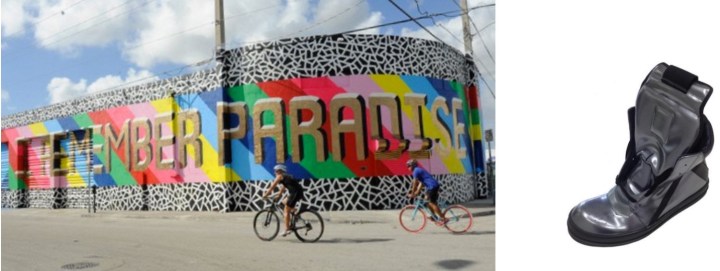
"I Remember Paradise" by British graphic artist Lakwena for the Women on the Walls program in the Wynwood Arts District of Miami paired with a AB/MB collab between Airball x Rick Owens, spawned by Alchemist boutique's basketball-inspired pop-up.

“I Remember Paradise” by British graphic artist Lakwena for the Women on the Walls program in the Wynwood Arts District of Miami paired with a AB/MB collab between Airball x Rick Owens, spawned by Alchemist boutique’s basketball-inspired pop-up.

The noun of art filled the Miami fairs, but the verb thrived in Wynwood Arts District, a grid of warehouses reborn as an international street-art mecca. Creativity seems to run wild and free in Wynwood, but those seams frayed early Friday morning when a graffiti artist fleeing an undercover unit was hit by the police car. Delbert Rodriguez, a 21-year-old known by his tag Demz, died Tuesday night after spending the weekend in a coma. He is the second street artist in a year to bear the brunt of the city’s anti-graffiti efforts; in 2013, Miami Beach police caught Israel “Reefa” Hernandez-Llach, 18, spray painting an abandoned McDonald’s and Tased him to his death.

These tragic accidents highlight the dichotomy of urban expression. Street art is the pulse of Wynwood, so much so that graffiti feels permissible. A stroll last Saturday through the buzzing barrio found countless graffiti artists at work, ladders propped against walls, spray paint cans peppering sidewalks. Nearly every gallery, boutique and restaurant references graffiti in some form, from the graphics framing their exteriors to the pop palettes of their products. The corner where Rodriguez was spotted tagging – NW 5th Avenue and 24th Street – is a palimpsest of signatures, names the police read as evidence of wayward ambition. “We have people that come into the city that think they’re artists and start graffiting everything,” Miami Police Chief Manuel Orosa told the Miami Herald. The undercover unit, deployed specifically during Art Basel, aimed to quell such activity.

Inherent in Orosa’s comment is a disdain for outsiders, those from outside Miami and those outside the law. Rodriguez was not the former having grown up in Pembroke Pines, a Miami suburb, nor explicitly the latter as he was working within the artistic vernacular of Wynwood, a vernacular of spray paint and self-promotion. Of course, there is a difference between illegal graffiti and commissioned murals. The assumption could be made that the artists working by day during Art Basel were sanctioned, while those tagging at night were not. Many Wynwood murals have been marred by errant tags. And yet, all forms of street art share a common language and compulsion, both of which feel embraced in this urban enclave.

In Miami, the cross-currents surrounding self-expression came to a head last Friday: protesters decrying police violence blocked I-95 through Midtown Miami; Art Basel art-buying reached a fever pitch; Wynwood flaunted its street-cred creativity; and Rodriguez fled from police, spray can in hand. The nostalgic note of Lakwena’s 2013 mural seems to ring all too true in light of the tragedy: “I remember paradise.” A paradise lost.

comment 0

Dune bug

Screen Shot 2015-11-15 at 8.28.12 PM

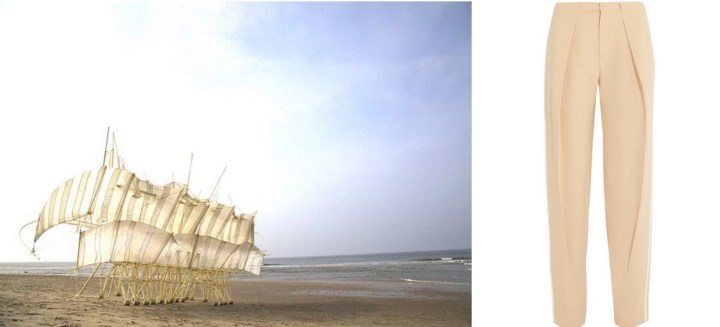
One of Theo Jansen’s Strandbeests (photo c/o Strandbeest.com) paired with Chloé Crepe Tapered Pants.

Miami was where the wild things were last weekend, a rumpus idealistically led by the Strandbeests, Theo Jansen’s herd of articulated sculptures.

In 1990, Jansen wrote a column for the Dutch newspaper de Volkskrant proposing a creative antidote to rising sea levels and the potential re-flooding of Holland: build creatures capable of restoring the land-water balance by autonomously displacing sand back to the dunes. Jansen concluded his clarion call with a promise to spend a year figuring out such an environmental feat/fleet.

A quarter century on and he’s still at it, tinkering away at the species he has spawned using plastic plumbing tubes (butter yellow in Holland). His evolutionary process began with discovery of an algorithm for a pivoted foot and double-jointed leg that could languidly graze the ground and thus ensure stability in sand, a core anatomy that survives today amid augmentations like sails and pumps. With the push of a hand or a gust of wind, the crankshaft at the core of every Strandbeest comes to life, stirring multiple pairs of legs into step. On a beach, their movement seems ethereal, an otherworldly actor aloft a sandy stage.

Sadly in Miami, the Strandbeests felt beached in poshness. To restore some of their intrinsic magic, I turn to the inventor twinkle captured in Ian Frazier’s 2011 profile of Jansen for The New Yorker. In it, Jansen describes his “very curly” creative route. “A real engineer would probably solve the problem differently, maybe make an aluminum robot with motor and electric sensors and all that. But the solutions of engineers are often much alike, because human brains are much alike. Everything we think can in principle be thought by someone else. The real ideas, as evolution shows, come about by chance. Reality is very creative. Maybe that is why the Strandbeests appear to be alive, and charm us. The Strandbeests themselves have let me make them.”

The charm of chance: Frazier recalls his first sighting of a Strandbeest, via a video played on a laptop, pulled out at a restaurant in Manhattan: “To see inanimate stuff come to life that way was wild, shiver-inducing — like seeing a haystack do the Macarena.” (Van Gogh must be chuckling.)

I wish I had witnessed the Strandbeests in isolation, far from the visual barrage of Art Basel, on a wuthering shore somewhere. There I could have experienced, in situ, the seemingly effortless geometry of Jansen’s sculptures (or Chloe’s perfectly pleated pants) galloping with the wind toward a bright horizon.

comment 0

Miami cocktail

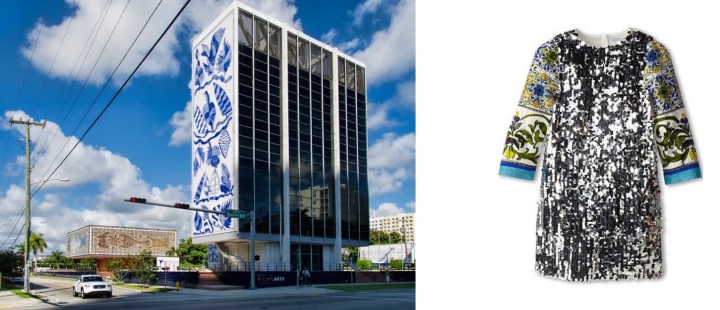
Once the Bacardi plaza, now home to the National YoungArts Foundation in Miami, FL (photo by by Dan Lundberg) paired with Dolce & Gabbana Print Sequin Shift Dress (Big Kids).

Once the Bacardi plaza, now home to the National YoungArts Foundation in Miami, FL (photo by by Dan Lundberg) paired with Dolce & Gabbana Print Sequin Shift Dress (Big Kids).

When your reality is the buzzy mayhem of Art Basel Miami Beach, your fantasy becomes a moment of peace. This morning, I literally ran past this plaza on busy Biscayne Boulevard. Now, hours later, soles sore and mind brimming, I imagine returning for a nighttime respite.

The plaza tells a quintessentially Miami story: In 1963, the Bacardis commissioned Enrique Gutiérrez to design their USA headquarters after relocating their rum operations from Cuba. A collaborator of Mies van der Rohe, Gutiérrez imagined a modernist tower infused with Latin elements, expressed in buoyant murals by Brazilian artist Francisco Brennand (tile count: 28,000). Later, the family hired Ignacio Carrera-Justiz to create an annex, dubbed the Jewel Box after its shimmering glass mosaics based on German artist Johannes Dietz’s rum-inspired painting.

The latest page of this storied site is its recent purchase by the National YoungArts Foundation, an organization dedicated to nurturing young artists of all disciplines through scholarships. YoungArts has hired Frank Gehry to transform the plaza into its Miami campus anchored by the landmarked tower and annex, augmented by a new performing arts center of Gehry’s design.

A tale of two buildings; a tale befitting this creative cocktail of a city and this stylistic cocktail of a dress (scaled for girls à la YoungArts).

comment 0

Starry night

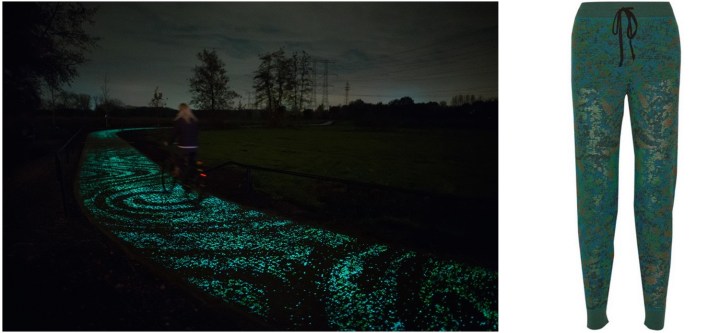
Dutch design lab Studio Roosegaarde recently opened the Van Gogh-Roosegaarde Cycle Path in Nuenen, Netherlands (c/o designboom) paired with M Missoni Metallic Track Pants.

Dutch design lab Studio Roosegaarde recently opened the Van Gogh-Roosegaarde Cycle Path in Nuenen, Netherlands (c/o designboom) paired with M Missoni Metallic Track Pants.


A Sunday in sweatpants could take a glamorous turn with a nighttime ride along this shimmering bike path in Nuenen, Netherlands in these twins-in-shimmer track pants. Vanguard Dutch design lab Studio Roosegaarde applied its “techno-poetry” approach to a kilometer-stretch of paved pathway in the Dutch town best known as Vincent van Gogh’s roost from 1883 to 1885, a pastoral stint that culminated in his painting of “The Potato Eaters.” Evoking the master’s profound hand, the route is illuminated by thousands of solar-charged LED stones, swirling with the sparkling might of “Starry Night.” A conduit of culture, innovation, inspiration.

comment 0

Nailed it

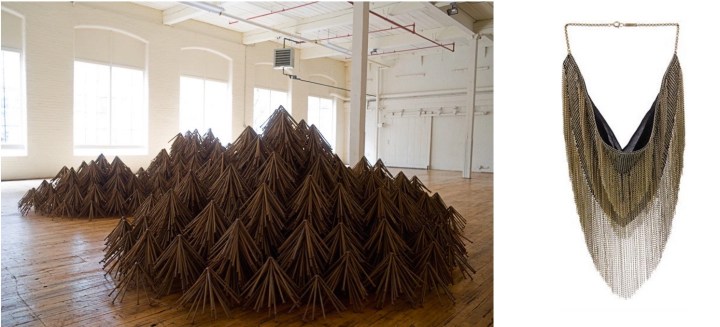
"Grove" by John Bisbee, whose sculptures filled the Shelbourne Museum in Vermont earlier this year paired with Isabel Marant Linares Fringed Chain Necklace.

“Grove” by John Bisbee, whose sculptures filled the Shelbourne Museum in Vermont earlier this year paired with Isabel Marant Linares Fringed Chain Necklace.

John Bisbee found his art form by literally kicking the bucket. Then a college student, disillusioned by the ceramic, glass and “really bad found-object sculptures” he was creating, Bisbee turned to scavenging for materials in an abandoned house. Wandering around, he bumped a pail filled with nails. Instead of spilling, the nails tipped out as a block, rusted into the form of the bucket. “I was, like, ‘This is way better than the crap I’m making,’” he told American Craft.

Three decades on and Bisbee is still working with nails (as an artist-in-residence at Bowdoin College in his native Maine), ever experimenting with greater scale. “It always has to be fresh and wow me on some level, because I get bored very easily. If I’m not chasing some new configuration or verb, I get depressed.”

Bisbee’s current material muse are bright commons, the largest standard spikes commercially available at 12 inches. He tinkers with the rods, sometimes exploiting their straightness into grand equations of geometric precision; elsewhere, he achieves organic, flowing monuments. “A nail, like a line, can and will do almost anything,” he said. “What can’t you draw with a line? The nail is just my line.”

Eschewing sketching, Bisbee works directly with the metal – hammering, welding, bending. A small crew helps him now, many former students, “my team of handsome athletes,” who have helped unleash him to explore and explode his sculptures.

“You’d think that you would sort of choke off your options and potential, the more you keep excavating one item,” he said. “but I find it’s the opposite – it explodes. There are so many amazing tangents that I haven’t had the time to take; so many great insights that are buried years back, so it’s ever expanding this mundane object.”

Here’s to filling life with amazing tangents (and nail-fringe necklaces).
comment 0

Illuminated underline

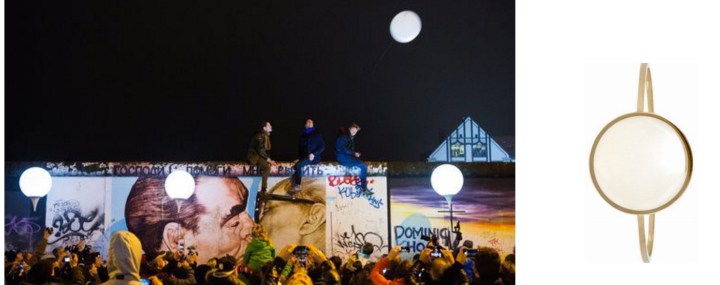
"Border of Light" balloons were released into the sky last night in Berlin (c/o The New York Times/ Lukas Schulze of European Pressphoto Agency) paired with Isabel Marant Buffalo Bone Bangle.

“Border of Light” balloons were released into the sky last night in Berlin (c/o The New York Times/ Lukas Schulze of European Pressphoto Agency) paired with Isabel Marant Buffalo Bone Bangle.

Cheers sent 8,000 balloons flying last night in Berlin. The illuminated orbs, part of the 25th anniversary celebration of the fall of the Berlin Wall, evoked the border that once divided the city, the country, the world.

“The wall was heavy, was big, was dark,” said Berlin-based lighting designer Christopher Bauder, who conceived of the three-day installation with his brother, Marc. “We wanted to contrast it with something ephemeral, light and potentially beautiful.”

Lichtgrenze, or Border of Light, retraced eight miles of the former fortification in a glowing dotted line. Suspended from poles, each balloon bore a message of hope or congratulations, sourced on social media, echoing the heroic smuggling of messages across the border by East Germans.

“We wanted people to be able to participate, for it effectively to come from the people, as it did back then,” said Moritz van Dülmen, director of Kulturprojekte Berlin, the organizer of the anniversary event. “Back then it was the people who freed themselves.”

“Remembrance belongs to the people,” Marc Bauder said. “We want to offer an individual access instead of a central commemoration.”

On Sunday night, Border of Light dissolved into the night sky, as one by one the biodegradable balloons were released, signaling the end to the memorial weekend. In a city where roughly half of its residents did not directly experience the Berlin Wall, the light installation served as a beacon of freedom – its legacy and responsibility. Those who endured the brutality looked on with heavy memory. Berliner Tina Krone observed in The Guardian: “I haven’t seen that many people on the streets for 25 years.”

comment 0

Civic duty

Voters at St. Sophia Greek Orthodox Church today in Albany, N.Y. (AP Photo/Mike Groll) paired with Kids' Puma for Crewcuts Whirlwind Sneakers.

Voters at St. Sophia Greek Orthodox Church today in Albany, N.Y. (AP Photo/Mike Groll) paired with Kids’ Puma for Crewcuts Whirlwind Sneakers.


“We pave the sunlit path toward justice together, brick by brick,” Tim Cook wrote last week. “This is my brick.”