comment 0

Connect four

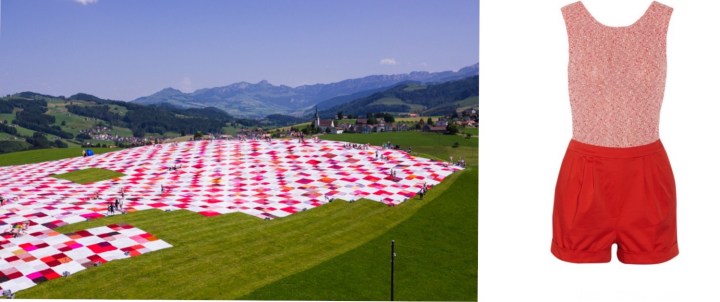
Bignik in Stein, Switzerland paired with Alice + Olivia Lulue Boucleé and Stretch Woven Playsuit.

Bignik in Stein, Switzerland paired with Alice + Olivia Lulue Boucleé and Stretch Woven Playsuit.


Twin brothers Frank and Patrik Riklin imagine a world blanketed in a picnic, a world marked by community contributions and fellowship. This summer, they’re hosting a petite picnic by their standards, palatial by everyone else’s, on a patchwork blanket covering nearly 4 acres of countryside in the Appenzell region of Switzerland. With the goal of swelling the blanket to span 100 football fields by 2040, the brothers are starting small, staging their first Bignik last summer and their second now. With cloth culled from neighboring towns – towels, curtains, sheets, tablecloths – the brothers sewed simpatico squares and then velcroed the modules together (not unlike this playsuit’s piecing together of a bouclé tank and woven shorts). Some 1,500 people have visited Bignik – picnicking, sunbathing, traipsing, snoozing. “[Art] should be experienced amidst life,” the brother artists have said. As their art has been, amidst my favorite summer pastime.

comments 2

Urban vertigo

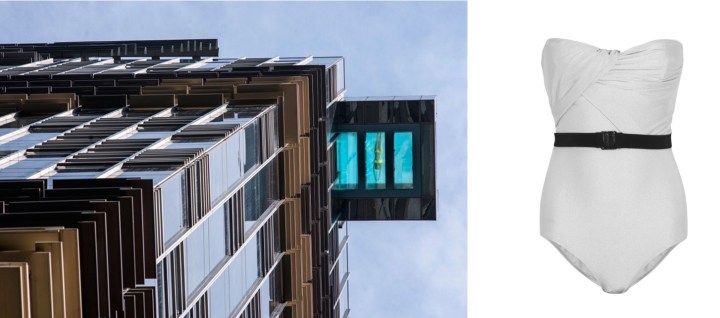
The cantilevered rooftop pool at Hotel Indigo in Hong Kong paired with Zimmermann Oasis Ruched Swimsuit.

The cantilevered rooftop pool at Hotel Indigo in Hong Kong paired with Zimmermann Oasis Ruched Swimsuit.


I lied: one more aqua moment, in the high-flying form of a glass-bottomed pooled cantilevered from the roof of Hotel Indigo in Hong Kong. Submerged in the luxury oasis designed by Aedas, I will don this sophisticated swimsuit as I do laps 29 stories above the pedestrians pitter-pattering around Wan Chai.

comment 0

Crystal clear

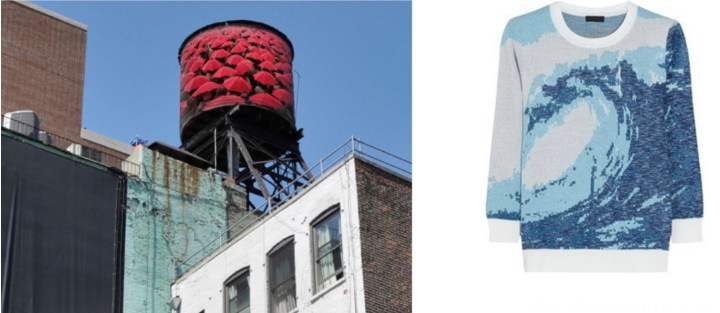
The Water Tank Project in New York City paired with J.Crew Wave-Intarsia Metallic Sweater.

The Water Tank Project in New York City paired with J.Crew Wave-Intarsia Metallic Sweater.


The last word on water (for now). Wooden tanks filled with potable water pepper the New York City skyline. Iconic and prolific, the city’s 17,000 water towers stand as symbols of hydro-abundance in America. Silent sentinels, until now.

Mary Jordan, a filmmaker/activist/curator, is making Manhattan’s towers speak for the billion people around the world without access to clean water by wrapping each tank in a piece of water-conscious art. Jordan came up with the concept seven years ago, after falling ill in a remote Ethiopian village during a documentary shoot. The women who nursed her back to health asked for only one favor in return: tell the world about the water crisis that plagues our daily lives; about the 8 hours a day we spend collecting it; about how even this hard-won water is often contaminated.

“I came back to New York and I looked up and saw these icons, these water tanks, and decided let’s transform them into an awareness campaign using art,” Jordan said. “And that’s when I established Word Above the Street – to put these things to work.”

As one of the largest public art shows ever staged in New York, The Water Tank Project finds the city awash in water imagery made by more than 100 established and emerging artist, including public school students. Parties, tours, talks and programs further amplify the awareness campaign. Jordan and her nonprofit crew at Word Above the Street aim to alter attitudes and habits among those who spot the art tanks, among us Americans, who use about 100 gallons of water per day, as compared to the two to five gallons used by the average person in sub-Saharan Africa. After its summer stint in NYC, The Water Tank Project will travel around the world, making stops in Mumbai, Rio de Janeiro, Sydney and Mexico City.

Conceptual photographer Laurie Simmons created a picture for the project – of a latex doll plunging in a pool – and applauds the mission for stoking both water and aesthetic awareness. “When I first came to Manhattan in 1973 as a young artist, I remember looking up all the time. The water tank near where I lived on Houston Street was a symbol that I had really arrived,” Simmons said in Elle magazine. “I hope that this project jolts people into an awareness to be less wasteful, because safe water should be part of the basic package of your human rights.”

On my next trip to NYC, I vow to look up and let pixelated awareness crash over me like the wave on this sweater.
comment 1

Pool party

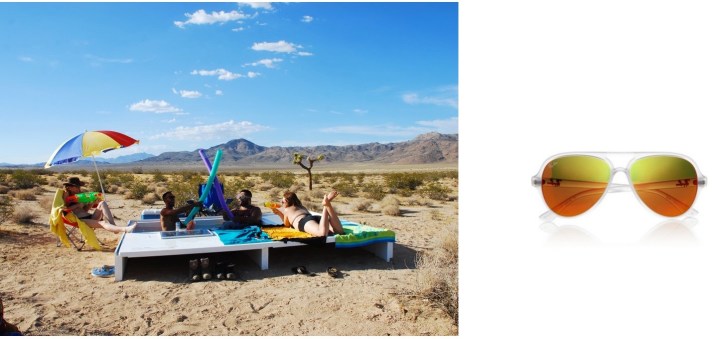
"Social Pool" by Alfredo Barsuglia in the Mojave Desert, CA (Photo c/o ihopeyouenjoythis.com) paired with Ray-Ban Aviator Acetate Sunglasses.

“Social Pool” by Alfredo Barsuglia in the Mojave Desert, CA (Photo c/o ihopeyouenjoythis.com) paired with Ray-Ban Aviator Acetate Sunglasses.


Another meeting of sand and water (can you tell I’m landlocked?), though this time self-consciously so. Last month, Austrian artist Alfredo Barsuglia planted Social Pool in the Mojave desert of Southern California, a nod to other land art installations in remote Western regions: Walter de Maria’s The Lighting Field in New Mexico; Robert Smithson’s Spiral Jetty outside Salt Lake City, UT.

The 11-by-5-feet invitation is open to anybody willing to trek into the desert, sans signs. In a scavenger hunt-meets-art scene mashup, access is granted to small groups by stopping by the pool’s presenter, the MAK Center for Art and Architecture in West Hollywood, which supplies the GPS coordinates and keys to open the cover (this is a no-reservations affair; only four keys exist, checked out for 24-hour stints). After driving several hours outside LA, visitors must park and search by foot. With no markers leading the way, Barsuglia challenges people’s desire for secluded personal enjoyment. The piece, Barsuglia told the LA Times, “is about the effort people make to reach a luxury good,” an apt description of this splashy picture of a recent pool party. Pools, signifiers of wealth, often languish in backyards, reflecting their owners’ nonchalance to water privation (particularly acute in parched California). In Barsuglia’s lexicon, water becomes a participatory element: each party is asked to pack in a gallon of water to replenish the pool (a solar-panel-fueled filter and chlorine system maintains cleanliness). Water is also listed on the packing list, alongside food and sun protection (for the latter, I would sport these mirrored Ray-Bans, a flashiness in keeping with the bling bent of the work).

With a month under its belt and two more to go, Social Pool is stirring varied reviews. Some visitors seem to be having the proverbial journey-trumps-destination experience. Lukas Mandrake, a NASA scientist, was drawn to “the idea that it was hard to find… something to earn, not merely see,” he emailed LA Times culture reporter Carolina A. Miranda. “A pool that all can go to but almost all won’t go to implied a sense of exclusivity not based on money but personal interest.” Mandrake described the dubious trek – along poorly maintained dirt roads, in the scorching heat – and then the arrival at such an incongruous site, a minimalist wood structure out of place in the brush, a strange “cross between some alien planet and someone’s backyard DIY gone very odd.” Replete with an “absurdist purple octopus thermometer.” Ultimately, the pool’s improbability made the day worthwhile for Mandrake and crew. “It was a whimsical creation of pure enjoyment and beauty put in a place where it cannot possibly survive – a cut flower on a dinner table.”

comment 0

Summer stand

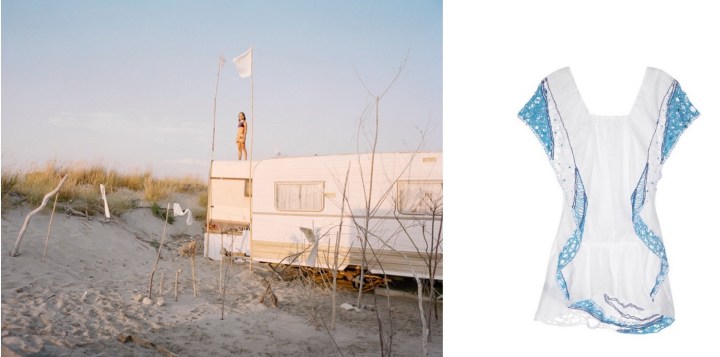
Princess Tina in Piémanson, France, photographed by Vasantha Yogananthan paired with Emamó Crochet-Trimmed Linen Kaftan.

Princess Tina in Piémanson, France, photographed by Vasantha Yogananthan paired with Emamó Crochet-Trimmed Linen Kaftan.


A bastion of wild amid a tourism-sanitized coastline. Every summer for some 30 years, a cadre from across Europe sets up camp at Piémanson, a beach in the south of France’s Camargue Regional Nature Reserve. More than campers, these “doyens,” as they are known, create a community devoted to communal, coastal living. At summer’s end, they vanish, returning to their real worlds, leaving no trace, save for the documentary pictures captured by Paris-based photographer Vasantha Yogananthan, who spent five summers documenting this scruffy utopia.

Inspired by Princess Tina atop her trailer throne, I want to take a summer stand in the sand in this kaftan with crochet fins.

comment 0

Pit stop

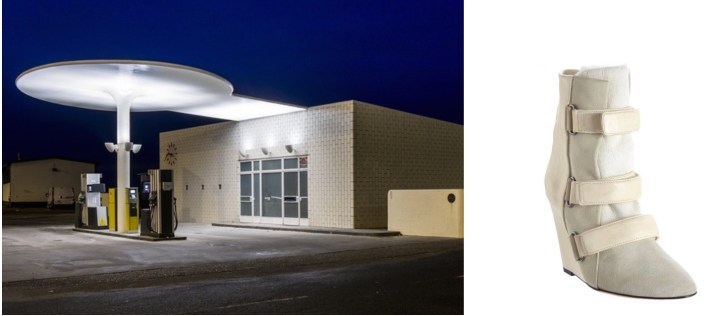
The Uno-X petrol station in Skovshoved, Denmark paired with Isabel Marant Scarlet.

The Uno-X petrol station in Skovshoved, Denmark paired with Isabel Marant Scarlet.


Yes, this is a gas station. And yes, I’m encouraging you to stop here. Because this isn’t any old fill-up. Modernism master Arne Jacobsen designed this unmanned petrol station just outside his native Copenhagen, a glowing example of his vanguard sense of functionalism and proportion. Built in 1936, the Skovshoved station stands as a simple concrete box, clad in ceramic tiles, a structure made transcendent by its service area: the canopy above the fuel pumps is an oval concrete shell suspended atop a lone column. At night, the Mushroom – as it’s colloquially known – becomes a sci-fi halo with underbelly illumination.

Still in service, the station has become a pit stop for empty tanks and architecture junkies. Ever game for sightseeing that blends athletics and aesthetics, I would rise to the occasion of a design-rich rideabout – mapped out by AFAR magazine – by donning these Isabel Marant boots, the Velcro straps echoing the canopy’s arc. Modernism in motion.

comment 1

Cloud nine

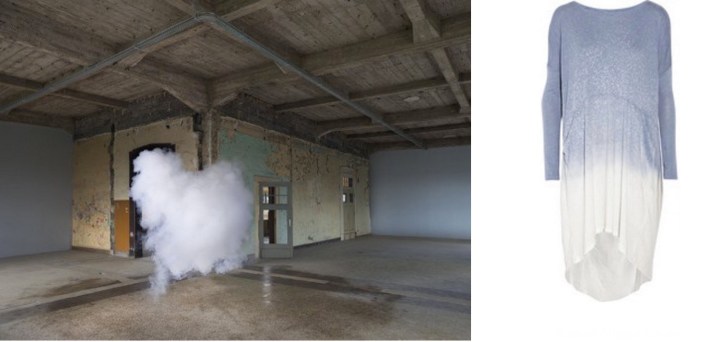
"Nimbus Thor" by Berndnaut Smilde (2014) paired with Raquel Allegra Shredded Spray-Dye Dress.

“Nimbus Thor” by Berndnaut Smilde (2014) paired with Raquel Allegra Shredded Spray-Dye Dress.


Thunderstorms have swept over the mountains every evening this week, streaking the sky in moisture and light, only to dissolve by daylight – an ephemeral squall made material by Dutch artist Berndnaut Smilde. Part smoke-and-mirrors, part alchemy, all art: carefully calibrating the atmospheric conditions within a space, Smilde rigs a suspended assemblage of stuff – two smoke machines held up by seat-belt brackets, ventilators taped to tripods, spotlights holding court nearby. He then flicks everything on. For a fleeting moment, a cumulus cloud hovers indoors while his camera snaps feverishly, fearing the inevitable collapse. If he’s lucky, he’s captured one of his surreal Nimbuses, a photography series he has sent around the world, now resting at the De Hallen exhibition space in Haarlem, the Netherlands as part of the group show, SKY! – in Dutch Art since 1850 (through September 7).

Smilde sees his work within the historical context of Dutch painting: light always looms large in Dutch landscapes, reflecting on the water, bouncing back into the clouds. His choice of spaces – coolly clean, mysterious – references the domestic scenes of Vermeer. “It’s almost as if,” Smilde has said, “a cloud from one painting floated into a Dutch interior.” Or onto a languid dress.

comment 0

Flashdance

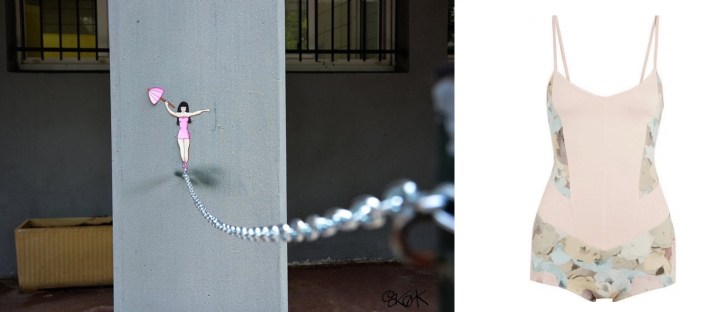
A micro-intervention by oakoak in St. Etienne, France paired with Live the Process Floral Stretch-Jersey Leotard.

A micro-intervention by oakoak in St. Etienne, France paired with Live the Process Floral Stretch-Jersey Leotard.


A micro art moment, again in France. In the former industrial town of Saint-Étienne, street artist oakoak transforms infrastructural cracks and quirks into creative vignettes starring blithe superheroes and pop characters. Oakoak describes his art as an effort to make his native city “less grey and at the same time, funnier.” He scans the city on daily walks, looking for interesting minutia – broken walls, bent railings, concrete fissures. When he spots something, he stops to study and measure the site, and then returns home to draw and draft before coming back later to collage. This prim ballerina, on pointe on a chain barrier, reminds me of my childhood days in ballet classes, clunky sessions saved by the reward of watching “Flashdance” ad nauseam. So on this meandering Monday, I’m channeling (leotard-induced) balance.

comment 1

Eye witness

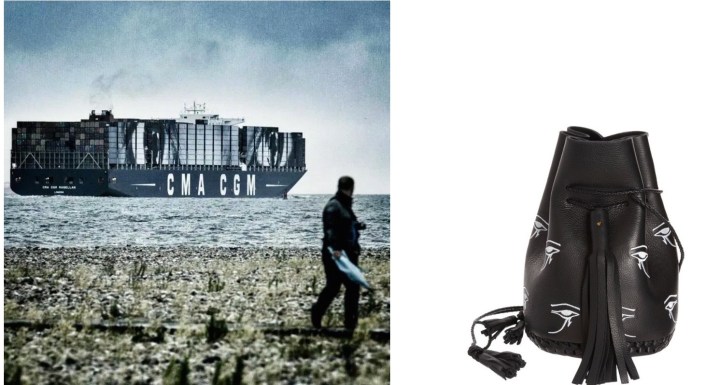
Story on the Sea by JR left France this week and is bound for Malaysia, paired with Wendy Nichol Eye of Horus Bag.

Story on the Sea by JR left France this week and is bound for Malaysia, paired with Wendy Nichol Eye of Horus Bag.


Another story at sea, but this one arrives in a state of becoming. A week ago, JR, a French photograffeur and TED Prize winner, installed a new work at the Le Havre port in France. And then it sailed away. The installation: a towering pair of eyes pasted across rows of shipping containers aboard a freighter bound for Malaysia. Follow the Magellan’s journey here or on JR’s Instagram .

Story on Sea builds on the global movement JR began in 2007, Women Are Heroes. To pay tribute to brave women who are essential yet vulnerable in their societies, he took photographs of their gazes and made them into massive murals. “They gave their trust and they asked for a single promise: Make my story travel with you,” JR wrote. So he did just that, flyposting their visages on walls around the world: on a brick wall in India, a train in Kenya, a favela in Brazil, a demolished house in Cambodia. He made them eye-catching eye witnesses (a watchfulness reminiscent of this Wendy Nichol drawstring bag).

In spite of its far-reaching scope, Women Are Heroes felt unresolved to the artist. “I wanted to finish Women Are Heroes with a ship leaving port,” he said, “with a huge image which could look microscopic after a few minutes, with the idea of these women who stay in their villages and face difficulties in the regions torn by wars and poverty facing the infinity of the ocean.” So now, four years on, he has finally given face to this finale: he and a crew spent 10 days pasting 2,600 strips of paper on containers filled with stuff bound for somewhere else, somewhere far away, stuff bound for a different life.

“I have no idea where and how people will see this artwork,” he wrote on July 5, “but I am sure that some women far away will feel something today. And in Le Havre, we are exhausted and proud.”

comment 0

Formidable foe

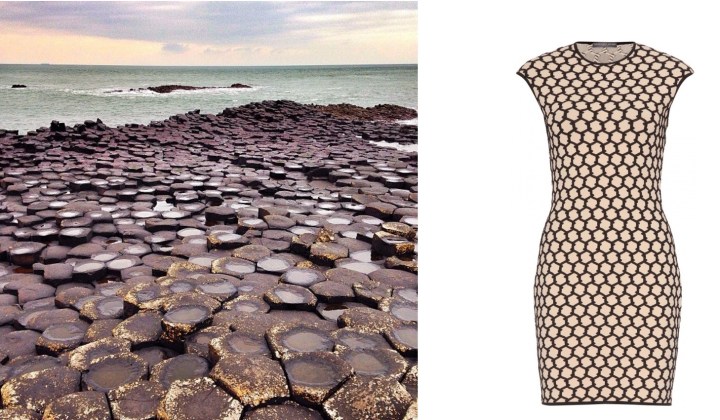
Giant's Causeway in Bushmills, Northern Ireland paired with Alexander McQueen Honeycomb Knit Dress.

Giant’s Causeway in Bushmills, Northern Ireland paired with Alexander McQueen Honeycomb Knit Dress.


A legend linked to a landform: Irish giant Finn McCool seethed with hate for his hulking rival Benandonner (a love-torn giantess may have been the root of their aversion). Finn and Ben (my nickname) shouted insults at each other across the North Channel, unable to physically fight because no boat was big enough to carry their bulk. A raging bull, Finn built a causeway between the shores, a Herculean task that tired him so, he fell fast asleep upon laying the last stones. Finn awoke to see Ben barreling toward him, a formidable foe at almost twice his size. Frightened into fleeing, Finn let his wife swaddle him in blankets, simulating a sleeping bundle beside the fire. Mrs. McCool, keeping her cool, welcomed in her husband’s enemy, asking him to wait by the hearth with the baby. Seeing the massive lad, the Scot assumed Finn must be comparatively colossal, so he scurried back to Staffa, tearing up the causeway as he went.

Ergo the broken outcropping of basalt columns, mirrored on both shores, left by the same ancient lava flow. Northern Ireland’s version, Giant’s Causeway, finds 40,000 interlocking posts leading from the cliff foot into the sea, most hexagonal and low, but some standing 39 feet high.

The cobbled causeway reminds me of the Holy Grail booby traps in “Indiana Jones and the Last Crusade,” the second of which riddles “The Word of God: Only in the footsteps of God will he proceed.” Sub giant and you’ve got this gorgeous Irish gangplank, which I picture myself teetering across in this haute hexagonal dress.